Getting Beyond Better: How Social Entrepreneurship Works

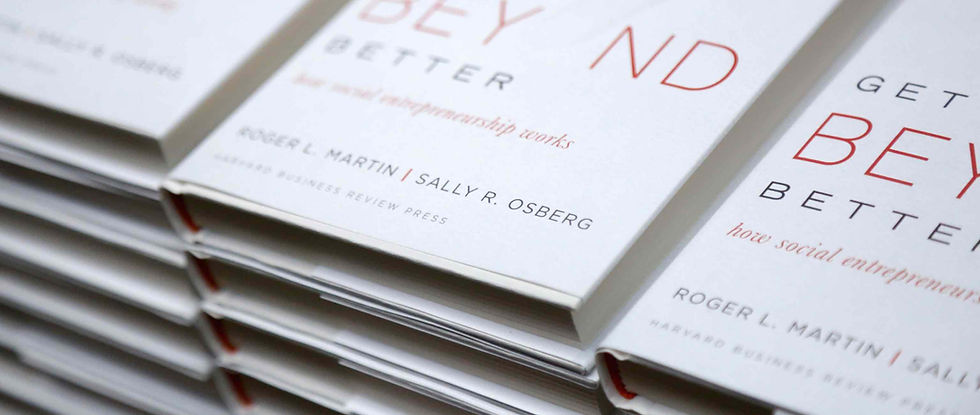
"Getting Beyond Better: How Social Entrepreneurship Works" by Roger L. Martin and Sally Osberg is a must-read for anyone interested in the powerful role social entrepreneurs play in reshaping the world. In this book, Sally and Roger provide a deep dive into how social entrepreneurs identify problems and disrupt systems to achieve transformative, rather than merely incremental, change.
What is Social Entrepreneurship?
Sally and Roger define social entrepreneurship as a process that moves beyond mere charity or traditional business ventures. Instead of applying band-aid solutions to social problems, social entrepreneurs "get beyond better" by completely transforming systems, industries, or communities. They create sustainable models that not only solve social challenges but also make a long-term impact by altering the root causes.
The Four-Stage Process of Social Entrepreneurship
The authors break down the journey of social entrepreneurship into a four-stage process:
Understanding the world: Social entrepreneurs have a unique ability to see and understand the systemic problems others overlook. They engage deeply with the world around them, identifying gaps and injustices that need to be addressed.
Envisioning a new future: With a vision for a better world, social entrepreneurs craft innovative and bold solutions. Unlike traditional businesses focused on incremental improvements, social entrepreneurs imagine a completely new reality where the problem no longer exists.
Building a model for change: The heart of the social entrepreneur’s work lies in building sustainable business models. These models balance mission with financial sustainability, ensuring that the solution can be scaled and sustained over time.
Scaling the solution: To truly transform society, social entrepreneurs scale their solutions. Whether through partnerships, replication, or expanding operations, they ensure their impact reaches beyond the local level and affects the entire system.
Case Studies: Social Entrepreneurs in Action
Throughout the book, Sally and Roger illustrate their ideas with real-world examples of social entrepreneurs who have successfully driven systemic change. One such example is Muhammad Yunus, the founder of Grameen Bank, who reimagined financial services for the poor, creating the microcredit model that has empowered millions of individuals globally.
Another example is Verghese Kurien, known as the "Father of the White Revolution" in India. By transforming the country’s dairy industry, Kurien provided millions of rural farmers with opportunities for economic independence, simultaneously improving nutrition across the country.
Social Entrepreneurship vs. Corporate Social Responsibility
The book makes a clear distinction between social entrepreneurship and corporate social responsibility (CSR). While CSR often involves companies giving back to the community or engaging in sustainability initiatives, Martin and Osberg argue that these efforts typically don’t address the root causes of social issues. Social entrepreneurs, on the other hand, seek to overhaul systems and industries in ways that truly solve the underlying problems.
Key Takeaways for Social Entrepreneurs
Think big: Social entrepreneurship isn’t about making small changes—it’s about transforming entire systems. This requires bold vision and courage.
Sustainability matters: No matter how passionate you are about your cause, your solution needs a solid, sustainable business model to thrive long-term. Social entrepreneurs need to balance mission with financial stability.
Persistence is key: Systemic change doesn’t happen overnight. Social entrepreneurs must be resilient, willing to experiment, and adaptable in the face of challenges.
Collaboration accelerates impact: Scaling a social enterprise often requires partnerships, both within the social sector and with traditional businesses. Collaborating with others can help social entrepreneurs maximize their impact.
Why You Should Read Getting Beyond Better
If you're a current or aspiring social entrepreneur, "Getting Beyond Better" offers valuable insights into what makes social enterprises succeed in creating transformative, lasting impact. The book provides a roadmap for understanding the process of social entrepreneurship and equips readers with the mindset needed to envision, build, and scale systems-changing solutions.
Sally and Roger’s framework serves as a powerful guide for those looking to leverage the principles of business to drive social change. Whether you’re just starting or looking to scale your impact, this book is a thoughtful and practical resource for social entrepreneurs ready to move beyond traditional methods of doing good—and get beyond better.
